Instructions for Use
DentalJect® DJ01000 · IFU-DentalJect Rev 4/2026
Thoroughly read this “Instructions For Use” before using the DentalJect for the first time.
This page reproduces the printed IFU for reference and accessibility. The PDF is the controlled version; if the two ever differ, follow the PDF.
Caution
Federal law restricts this device to sale by or on the order of a licensed healthcare practitioner.
DentalJect description
The DentalJect is a prescription device that dispenses a non-medicated, non-flammable vapocoolant blend as a topical anesthetic for intact oral mucosa.
Indication for use
The DentalJect is intended for topical application to intact mucous membranes in the oral cavity. The DentalJect is used to target a minimally sized cooling area for lessening pain associated with injections.
Precautions
- Apply only to intact oral mucosa. Do not spray onto open mucosa, ulcerated tissue, puncture wounds, or large areas of damaged mucosa.
- To maintain patient comfort, avoid spraying directly on sensitive (unanesthetized) teeth or teeth with exposed root surfaces.
- Do not spray directly onto dental plaque, as this may contribute to the spread of infection.
- Do not apply to skin or non-oral mucosal surfaces, including genital mucosa.
- Thin mucosa may require shorter or lighter application than thicker mucosa.
- Do not spray into a closed mucosal space.
- Do not spray into or near the eyes; use gauze or protective eyewear to prevent accidental exposure.
- The freezing-thawing cycle may cause transient discomfort and temporarily reduce local resistance to infection; use with appropriate clinical judgment.
- Use caution in patients with systemic or local conditions that may cause reduced saliva flow, impair mucosal integrity, healing, or immune response, which could cause frostbite or tissue sloughing (such as uncontrolled diabetes, dehydration or malnutrition, adrenal insufficiency, vitamin C deficiency, cancer, or autoimmune disease).
- Use caution when oral conditions are present that may complicate effective application or spread infection (such as macroglossia, sexually transmitted infections in the oral cavity, or unbiopsied lesions).
- Avoid repeated or prolonged application beyond the recommended spray duration.
- Discontinue use if irritation or unexpected tissue response develops.
Adverse reactions
Over-application to the same area may cause frostbite and/or alter pigmentation.
Contraindications
- Hypersensitivity to HFO-1234ze: (trans-1,3,3,3-tetrafluoroprop-1-ene) or Non-denatured Ethanol. If irritation develops, discontinue use.
- No salivary flow.
Warnings
- For oral use only.
- Contents under pressure. Do not expose the canister to temperatures above 120°F (50°C).
- DO NOT AUTOCLAVE the canister.
- Use only as directed. Intentional misuse by deliberately concentrating and inhaling the contents can be harmful and potentially fatal.
Contents
HFO-1234ze: (trans-1,3,3,3-tetrafluoroprop-1-ene), non-denatured ethanol (200prf) and peppermint oil flavor.
Storage
Do not expose the canister to heat or store in temperatures above 120°F (50°C).
Disposal
Do not puncture or incinerate the canister. Dispose of the canister in accordance with local regulations.
Pediatric note
Safety for the use of this device in pediatric patients has not been established; it is therefore recommended that the device should not be used in patients under the age of four years without the consultation of a pediatric dentist.
Keep out of reach of children.
Directions for use: assisted method
- Clean and sterilize DentalJect components according to the reprocessing instructions (Cleaning Procedure and Sterilization Procedure sections, below).
- Insert the DentalJect Canister into the DentalJect Applicator then twist and lock into place per Figure 1.
- Perform a quick ½-second test spray in the air to confirm the device is operating as intended.
- Explain to the patient that you are spraying the area to be injected with local anesthetic, which will create a cold sensation.
- If cleaning of the injection site is required, wipe the area with clean, dry 2x2 gauze according to your standard procedures. Ensure the area is NOT dry before spraying DentalJect, as salivary coating is necessary to develop the blanch.
- A saliva ejector, or High-Volume Extractor (HVE), should be used during the spray application to reduce the level of “fog” that may occur in the oral cavity.
- Perform a quick ½-second test spray in the air to confirm the device is operating as intended.
- Instruct the patient to gently and slowly exhale during the spray procedure.
- While positioning the nozzle, use caution and maintain awareness of the clinician performing the injection and the needle position.
- Avoid spraying vital teeth with exposed root surfaces.
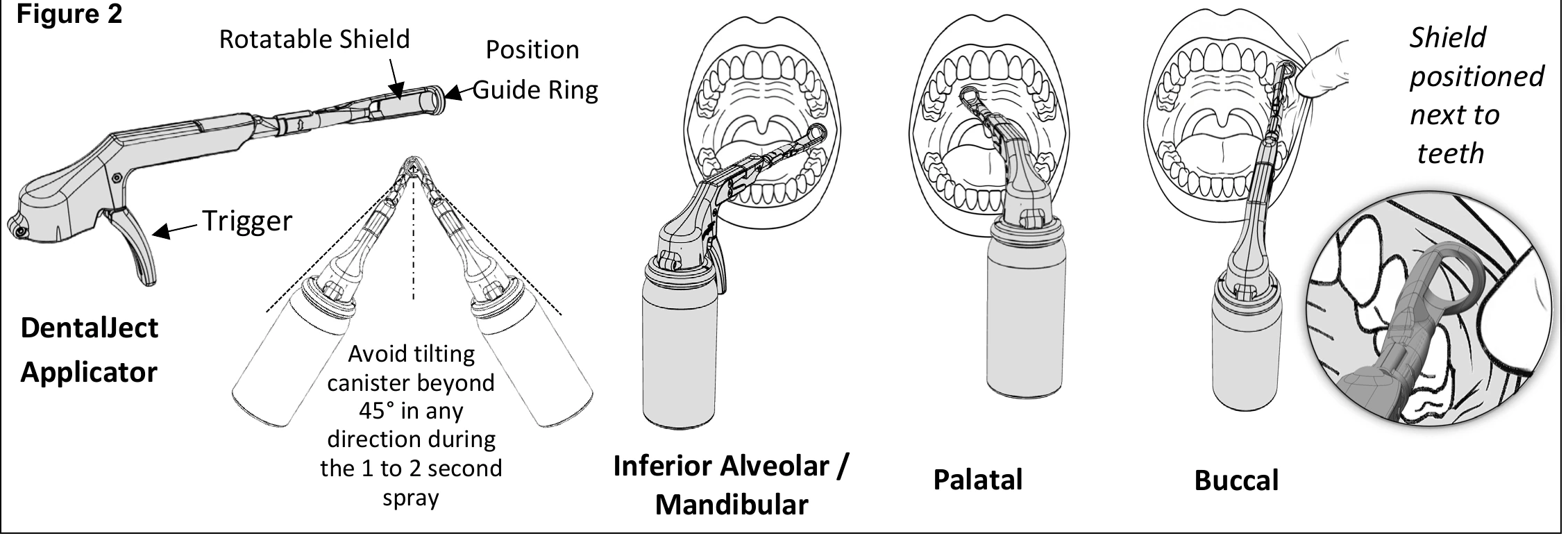
- Per Figure 2, position the Guide Ring on or up to 1 inch from the intended injection site, keeping the canister as upright as possible (less than 45° tilt) and orient the nozzle perpendicular to the targeted mucosa. The shield portion of the spray guide may be rotated to prevent any splash or flowback from contacting sensitive areas, if necessary. Pull the trigger for 1 to 2 seconds. This will dispense the vapocoolant blend at an approximate rate of 1 gram per second.
- Do not overspray the target area beyond the state of frost (ice crystals). A residual sensation of cold is considered normal. In most cases, the saliva coating will turn white (blanch); this is normal.
- Immediately perform the injection after the 1 to 2 second spray.

Note: The blanch indicates the most effective zone of numbing. Once this appears fully on the targeted area, do not spray for more than 1 second longer. The total spray time should not exceed 2 seconds.
Note: Even if the blanch does not occur, there will still be a short numbing effect. However, the most effective numbing lasts for 3 to 8 seconds after blanching occurs, and some decreased sensation may persist for up to a minute.
Reprocessing instructions for the DentalJect applicator
Note: The DentalJect Device is provided non-sterile and must be cleaned and sterilized prior to first use and every use thereafter. If possible, an automatic cleaning and sterilization method should be used. Manual cleaning is recommended only when an automatic method is unavailable.
Point of use: Wipe the DentalJect Applicator down between uses for the same patient, as soon as practicable, using disinfection wipes (e.g., CaviWipes™). Follow the steps below for reprocessing after use and between patients.
Pre-treatment and cleaning procedure
- Pre-soak the DentalJect Applicator in cold tap water for 5 minutes.
- Brush the DentalJect Applicator using a soft-bristle brush until all coarse residue is removed. Pay close attention to any difficult-to-reach crevices or mating surfaces.
- Rinse under cold running tap water for 1 minute, ensuring all surfaces are exposed to remove any gross debris.
- Place in an ultrasonic bath containing Prolystica 2x Concentrate Enzymatic Presoak and Cleaner, or equivalent, prepared at the minimum concentration according to the manufacturer’s instructions, at 45°C for 15 minutes.
- After being submerged in the ultrasonic bath for 5 minutes, move the trigger 5 times to loosen any remaining debris and allow the cleaning solution to penetrate non-rigid surfaces.
- Return the Applicator to the ultrasonic bath for an additional 10 minutes for a total exposure of at least 15 minutes.
- Remove the Applicator from the cleaning solution and rinse under running tap water for at least 1 minute.
- Perform a visual inspection to ensure that any visible debris has been removed. Repeat the steps above if necessary.
Sterilization procedure
Place the applicator in a 510(k)-cleared sterilization pouch or wrap, then use the parameters below.
| Cycle | Exposure temperature | Exposure time | Drying time |
|---|---|---|---|
| Gravity-displacement steam | 121°C (250°F) | 30 minutes | 30 minutes minimum |
| Dynamic air removal steam | 132°C (270°F) | 4 minutes | 30 minutes minimum |
Carefully inspect the applicator after sterilization for any signs of cracking, abnormal discoloration or material degradation.
Reprocessing instructions for the DentalJect canister
Point of use: Wipe down the canister between uses, as soon as practicable, using disinfection wipes (e.g., CaviWipes™). Follow local and state government requirements for disposal of aerosol containers.
Note: DO NOT AUTOCLAVE THE CANISTER.
- Disconnect the Canister from the DentalJect Applicator.
- Use a dry soft-bristle brush to remove any gross debris.
- Perform a visual inspection to ensure that any visible debris has been removed.
- Thoroughly wipe down the canister with disinfecting wipes (e.g., CaviWipes™), ensuring all surfaces are wiped, and no visible debris remains.
- Ensure that the canister’s surfaces stay wet for at least 3 minutes, or as instructed by the wipe manufacturer. Use additional wipes as needed to keep the surfaces wet.
- Allow the canister’s surface to air-dry. Do not rinse.
How supplied
| Item | Order code |
|---|---|
| DentalJect Applicator | DJ01000-00 |
| DentalJect Canister (net weight 40 grams) | DJ03000-01 |
| DentalJect Canister pack of 5 (net weight 40 grams ea.) | DJ03000-05 |
Manufacturer
Vapocoolshot Inc., Boca Raton, FL 33487. 1-844-827-3685. www.vcsmedical.com
Disclaimer: Use of the DentalJect® device is intended to improve patient comfort during injections and does not guarantee to always eliminate pain.
For more information about this product, please call 1-844-827-3685.